
Context & The Problem
A forced migration, not a discretionary redesign.
HG Insights is a B2B technology intelligence platform that helps sales, marketing, and revenue teams identify their ideal customers. Their data includes product installs, technographics, firmographics, account scoring, intent signals, and cloud dynamics — powering smarter prospecting and territory planning.
The Salesforce Connector allowed HG Insights customers to enrich their Salesforce accounts and leads directly with HG data — bringing technographic intelligence into the CRM where sales reps already lived and worked.
Due to security requirements, the existing Salesforce app could no longer be maintained — a full replacement was mandatory. This wasn't a discretionary redesign. It was a forced migration affecting 44 enterprise clients actively using the integration in their daily workflows.
The Challenge
Rebuild the entire integration experience — across both the HG Platform and the Salesforce App — without losing a single customer in the process.
44 enterprise clients dependent on the integration.
Two surfaces to design — HG Platform + Salesforce AppExchange.
Variable complexity — 500 to 20,000+ accounts per client.
Sales reps, Marketing teams and CSMs across 44 enterprise organizations.
My Role
Sole designer on the project, working directly with the Product Owner.
- Design for both surfaces end to end — the HG Platform connection experience and the HG Insights app inside Salesforce.
- All stakeholder interviews, run one-on-one.
- Synthesis, affinity mapping and prioritisation of findings.
- Facilitation of the How Might We session.
- Scope and sequencing with the Product Owner, who set priorities and carried the roadmap.
- The How Might We session itself, run with three cross-functional participants from product and engineering.
Research
Understanding the Problem Before Designing the Solution
Before touching any wireframe, I ran structured one-on-one interviews with 4 internal stakeholders who worked directly with the integration and with customers daily.
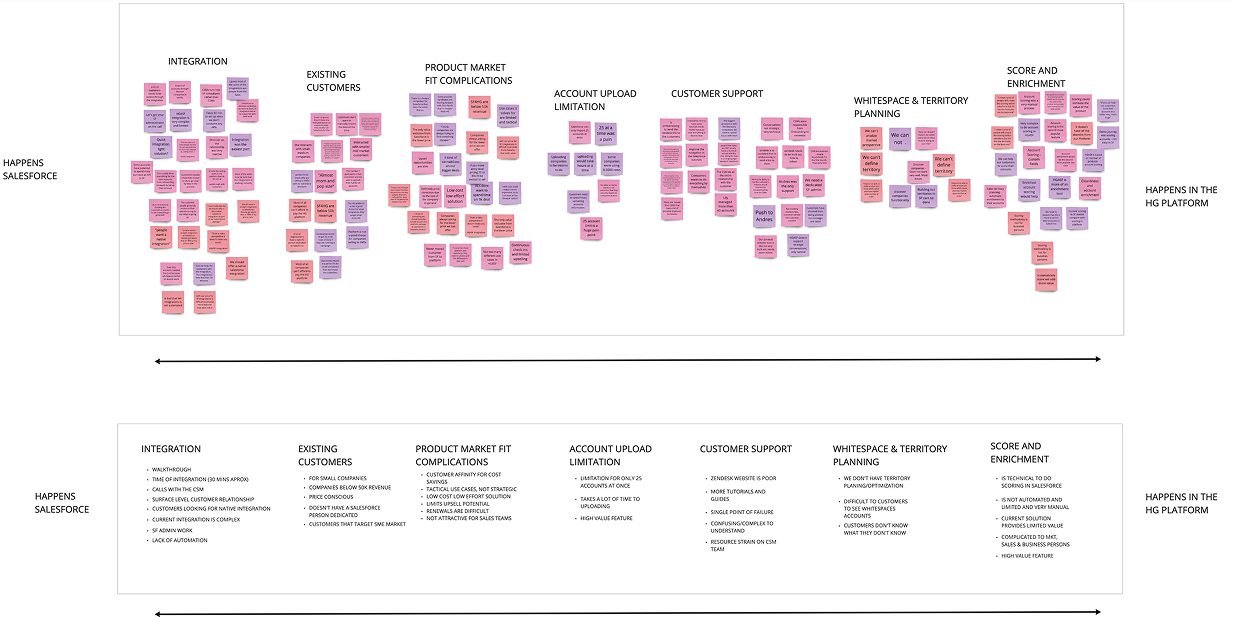
1-on-1 interviews with open-ended questions, followed by affinity mapping to cluster insights into themes.
Research Findings
What I heard — and what it meant
“The layout is very confusing.” — CSM
“People want a native Salesforce integration.”
“Quick integration, light solution.”
“HG4SF integration is very complex and limited.” — Solutions Engineer
Integration is broken
Setup takes 30+ minutes, complex and not automated.
Data is underutilized
Users can't score, enrich or plan territory from Salesforce.
Support burden is high
CSMs manage everything manually; Zendesk is the only channel.
Prioritization — What to Build First
Not all problems were equal. I mapped the findings against technical complexity and business value to focus the effort.

With the Product Owner, we focused first on Integration and Account Upload — the highest friction points, blocking all other value from reaching the user.
How Might We
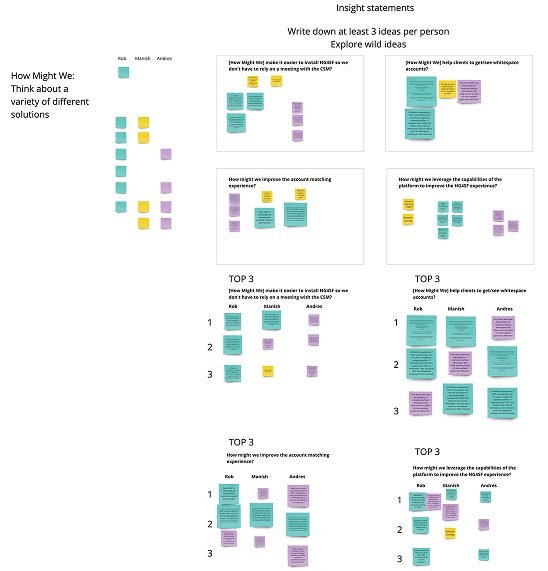
With the findings synthesized, I ran a collaborative ideation session to explore solutions before committing to any direction.
I facilitated a How Might We session with 3 cross-functional participants from product and engineering — generating ideas across 4 key challenge areas identified in research.
Rebuilding the Setup Path
The integration could not be fixed by restyling it. The sequence itself had to change.
Six steps became four, and none of them require another person to be available. The CSM moved from being a dependency to being support.
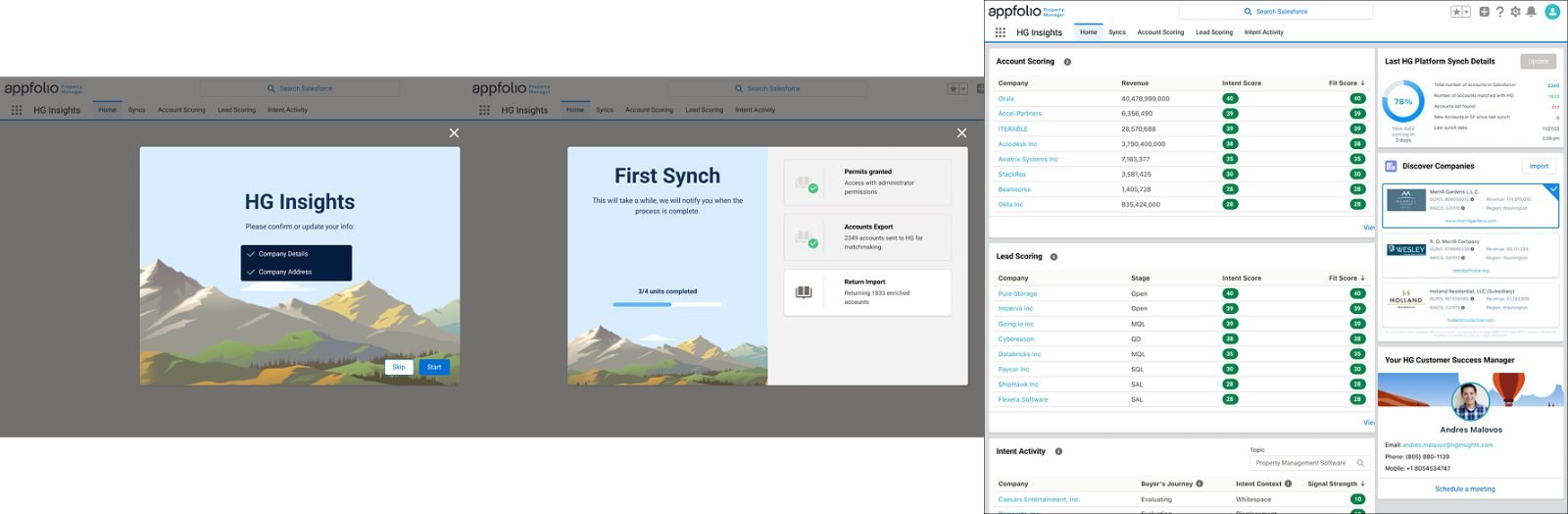
Final Design — HG Platform
Designing the connection experience from the HG side — clear, guided, and built for users who aren't Salesforce admins.
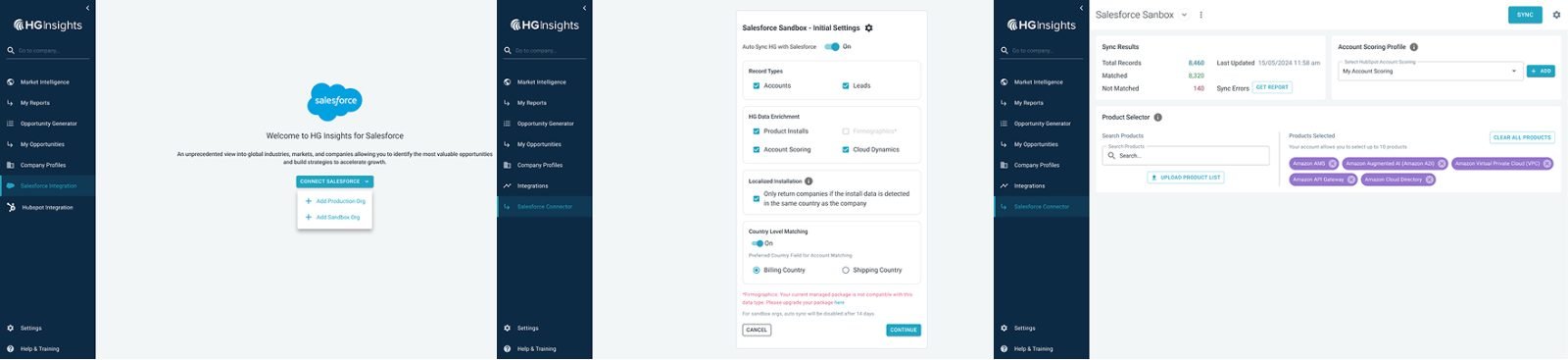
Final Design — Salesforce App
Designing the HG Insights experience natively inside Salesforce — where sales teams already work.
Results
A mission-critical migration delivered without losing a single client.
The migration was mandatory, so the question was never whether clients would move — it was whether any would leave while being forced to.
- Two surfaces designed simultaneously: HG Platform + Salesforce AppExchange.
- Design delivered in an environment with zero tolerance for customer loss.
Replacing a CSM-dependent integration with a self-serve experience — across two surfaces, for clients ranging from 500 to 20,000+ accounts.
What I Took From It
Designing inside someone else's platform is a constraint problem before it is a craft problem.
Design inside the host's rules
I read through Salesforce's platform documentation before designing, because the app had to feel native inside a product I did not control. Its patterns and limits shaped the design more than any preference of mine did.
Data volume is a design constraint
Moving large volumes of HG data into Salesforce has hard technical limits. Understanding them early changed how the matching and upload experience had to work — that constraint was not a detail, it was the shape of the solution.
What I would do differently
I would document the design decisions as they were made. With no PRDs and a single designer, the reasoning lived in my head and in conversations with the PO — fine for six months, fragile for anyone who inherits it.